Rotten Tomatoes
Cancel Movies Tv shows RT App News Showtimes

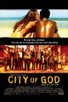
City of God

Play trailer Poster for City of God R 2003 2h 11m Crime Drama Play Trailer Watchlist
Watchlist Tomatometer Popcornmeter
91% Tomatometer 163 Reviews 97% Popcornmeter 250,000+ Ratings
In the poverty-stricken favelas of Rio de Janeiro in the 1970s, two young men choose different paths. Rocket (Phellipe Haagensen) is a budding photographer who documents the increasing drug-related violence of his neighborhood. José "Zé" Pequeno (Douglas Silva) is an ambitious drug dealer who uses Rocket and his photos as a way to increase his fame as a turf war erupts with his rival, "Knockout Ned" (Leandro Firmino da Hora). The film was shot on location in Rio's poorest neighborhoods.
Watch on Fandango at Home Stream Now

Where to Watch

City of God

City of God

What to Know

Critics Consensus

City of God offers a shocking and disturbing -- but always compelling -- look at life in the slums of Rio de Janiero.

Read Critics Reviews

Critics Reviews

View More
Anupama Chopra Film Companion 12/30/2019
What makes City of God so breathtaking is director Fernando Meirelles' passion for these people - he gives us the color, the music and the humor... Go to Full Review
J. R. Jones Chicago Reader 11/08/2011
I came away from this film impressed by its narrative control but unmoved by anything it had to say. Go to Full Review
Nell Minow Common Sense Media 12/22/2010
4/5
Powerful, but only for 17 and up. Go to Full Review
Paul Emmanuel Enicola Movie-Blogger.com 08/24/2024
5/5
A stark depiction of life outside the city: terrifying, unsettling, but never losing the sense of comedy. Go to Full Review
Blake Howard One Heat Minute 02/13/2023
4/4
“A gateway drug to world cinema … aesthetically pure… the world was bigger after I watched City of God.” Go to Full Review
Ray Pride Newcity 08/18/2022
7/10
What is the value of human life? And why are we so reckless with the fate of the youth of the world? Go to Full Review
Read all reviews

Audience Reviews

View More
Aasim R @Aasim 6h 10 OUTTA MUTHAPHUCKIN 10 (best Gangster Film I have ever seen) See more Johan M Nov 25 City of God Summary In the poverty-stricken favelas of Rio de Janeiro in the 1970s, two young men choose different paths. Rocket (Phellipe Haagensen) is a budding photographer who documents the increasing drug-related violence of his neighborhood. José "Zé" Pequeno (Douglas Silva) is an ambitious drug dealer who uses Rocket and his photos as a way to increase his fame as a turf war erupts with his rival, "Knockout Ned" (Leandro Firmino da Hora). The film was shot on location in Rio's poorest neighborhoods. Original title: Cidade de Deus Country of origin: Brazil (co-production with France) Date of production: First screened at the Cannes Film Festival on May 18, 2002. Directors: Fernando Meirelles and Kátia Lund Screenwriters: Bráulio Mantovani, adapted from the novel by Paulo Lins. Running time: Approximately 130 minutes according to various sources. Rating: Common Sense lists it as 17/18+ (depending on the region) for violence, drugs, strong language, and sexual content. (M) Main cast: Alexandre Rodrigues as Buscapé, Leandro Firmino ("Zé Pequeño" / Li'l Zé), Phellipe Haagensen ("Bené"), Douglas Silva ("Dadinho" as a child), Jonathan Haagensen ("Cabeleira"), Matheus Nachtergaele ("Sandro Cenoura / ‘Karotte’ in some translations") , Seu Jorge ("Mané Galinha"), Alice Braga also appears in some supporting roles. Supporting cast: Alice Braga as Angélica, Gustavo Engrácia as Barbantinho, Darlan Cunha as Filé-com-Fritas, Jonathan Haagensen as Cabeleira, Jefechander Suplino as Alicate, Rubens Sabino as Neguinho, Michel Gomes as Bené (child), Christian Luís as Zé Pequeno (teen), Thiago Martins as Lampião, Leandro Firmino da Hora as older Li’l Zé,Karina Falcão as Berenice, Matheus Nachtergaele as Sandro Cenoura, Edson Oliveira as Blacky, Daniel Zettel as Thiago, Douglas Silva as Dadinho (Li’l Dice as a child), Renato de Souza as Marreco, Charles Paraventi as Tio Sam, Gero Camilo as Paraíba, Paulo Lins (the original author of the novel) as a cameo role. Johan Mejía’s Cidade de Deus (City of God) Review For fans of crime and drama films, City of God was much more than just another story about gangs; it became one of the most powerful portrayals of poverty, violence, and human resilience ever brought to the screen. The film, directed by Fernando Meirelles and Kátia Lund and released in May 2002 at the Cannes Film Festival, is a Brazilian production based on the novel by Paulo Lins and adapted by screenwriter Bráulio Mantovani. What Meirelles and Lund achieved was something critics doubted could be done: synthesizing years of social decay, political neglect, and the rise of organized crime in the favelas of Rio de Janeiro into a single cinematic film, without losing the raw complexity of real life. Set in the housing projects of Cidade de Deus, the film's action takes place mainly between the late 1960s and early 1980s, and part of its power comes from the way it moves back and forth in time. Although Buscapé narrates the story chronologically for the most part, at least throughout the film it unfolds through flashbacks, which add depth to characters such as Li'l Zé, better known as Zé Pequeno, the main antagonist, Bené, Mané Galinha, and the younger versions of Li'l Zé and Buscapé played by Douglas Silva and Luis Otávio. This constantly changing timeline reflects the chaotic reality of the favela, a place where there seems to be no end to the cycle of crime and violence, passed down from generation to generation, and where lives are marked by past moments that seem impossible to escape. The social context of the film is crucial, as it takes place in a poor and marginalized community, populated mostly by children, teenagers, and young adults who grow up amid inequality, limited education, and the almost total absence of government protection. These characters are Brazilian, mainly Afro-Brazilian, and their culture, music, language, and daily struggles anchor the film in a very specific historical period marked by urban migration, government incompetence, and the growing power of drug trafficking. The energy, slang, color, and improvised economy of the favela create a world that feels alive even in its darkest moments. As a film, City of God fits perfectly into the genres of crime drama and social realism, with its coming-of-age narrative and characterization being one of the film's strengths. Buscapé is thin, observant, anxious, and thoughtful, a teenager whose psychological depth comes from his desire to free himself from the violence that surrounds him by becoming a photographer. Li'l Zé, on the other hand, is physically small, intense, unpredictable, and terrifying, shaped by childhood trauma and an ambition for power that becomes unstoppable. His brother from another mother, Bené, is charismatic and loyal, or as the film says, very cool for a criminal, while Mané Galinha represents a more traditional idea of masculinity and honor, with other secondary characters who, despite not standing out much, have very important impacts on the story, such as Angélica, Cabeleira, and Sandro Cenoura, who help complete the portrait of a community in which identity is marked by survival, loss, and opportunity. One of the film's strengths is the directors' ability to immediately immerse the viewer in the world of the favela. The cinematography is vibrant, frenetic, and spectacularly chaotic, and the editing is sharp and very good, turning even the most insignificant moments into something urgent. But something else worth highlighting is the acting, especially by the non-professional actors, which is incredibly real, and the music, with its mix of Brazilian funk, samba, and percussive rhythms, gives the film an unforgettable energy, although there are also scenes where the music is incredibly relaxing and the scene chaotic. The shifting timeline, which could easily have been confusing, actually adds emotional weight and helps reveal how violence escalates from childish pranks to full-scale war, which is a great detail as it forces the viewer to remember every past detail for it to make sense in the rest of the film, making every detail relevant to the rest of the story, whether through its influence or impact. Furthermore, the film's authenticity, moral complexity, and innovation make it easy to understand why City of God is often ranked among the best films in history. Personally, I found it extraordinary both for its narrative and its emotional impact. I loved its intensity, its honesty, and its cinematic audacity as a film. I found it extraordinary both for its narrative and its emotional impact. I loved its intensity, its honesty, and its cinematic audacity, as it is a film that not many dare to develop due to its complex themes and the difficulty of immersing the viewer in the story and making them feel part of it, which this film achieved completely, and I was fascinated by its narrative because of this. However, even a film of this scale has minor flaws, such as the fact that with so many characters introduced over two decades of narrative (in the film's story), it can sometimes be difficult to immediately identify the secondary characters or even the main ones, either because of their complex names or the sheer number of characters. In addition, the fast-paced, albeit brilliant, editing style can overwhelm viewers who prefer a slower or more linear narrative. Some characters who seem intriguing, such as Angelica or the Trio Ternura, do not receive as much psychological exploration as the protagonists, and at certain moments, the large amount of violence may seem excessive. Even so, these problems are insignificant compared to the film's overall achievements. In conclusion, City of God conveys a powerful message about how environment shapes destiny, how poverty and government neglect create cycles of violence, and how, even in the darkest places, people like Buscapé can find light through art and identity. The directors clearly intended not only to tell a dramatic story, but also to expose social realities that many prefer to ignore. As a viewer, I think they have succeeded brilliantly. Despite the brutality, the film never loses its humanity, and its combination of realism, artistry, and emotional depth makes it truly unforgettable. My overall opinion remains clear: City of God is a masterpiece that I loved, and a film that leaves the audience shocked and deeply moved when the credits roll. – Johan Mejía See more Jack F @MovieFan111 Nov 17 Not a fan. Definitely 18+. I just can't understand that 97 audience score. I mean, really? What the hell did you like about it?! See more Maksim S Nov 12 City of God is nothing short of a masterpiece of world cinema—relentless, brutal, and heartbreakingly human. Fernando Meirelles and Kátia Lund craft a raw, immersive portrait of Rio’s favelas, where violence is constant, survival is a gamble, and childhood innocence is shattered with unforgiving realism. The film doesn’t shy away from bloodshed or chaos, yet amid the carnage, it pulses with life, humor, and emotional depth. Its kinetic editing, unforgettable performances, and moral complexity make it as thrilling as it is devastating. Ultra-violent yet profoundly heart-felt, City of God is a cinematic tour de force—a film that lingers long after the credits roll and proves the transformative power of storytelling at its most uncompromising See more aasim r Nov 4 10/10 film...can't change that fact See more Tom F Sep 19 Perfectly constructed and excitingly told, with a boldness and emotional intimacy few Hollywood gangster movies can approach. See more Read all reviews
City of God

My Rating

Read More Read Less POST RATING WRITE A REVIEW EDIT REVIEW
City of Men 74% 78% City of Men Watchlist Carandiru 68% 85% Carandiru Watchlist Empire 21% 62% Empire Watchlist Paid in Full 53% 93% Paid in Full Watchlist Man on Fire 39% 89% Man on Fire Watchlist TRAILER for Man on Fire Discover more movies and TV shows. View More

Movie Info

Synopsis In the poverty-stricken favelas of Rio de Janeiro in the 1970s, two young men choose different paths. Rocket (Phellipe Haagensen) is a budding photographer who documents the increasing drug-related violence of his neighborhood. José "Zé" Pequeno (Douglas Silva) is an ambitious drug dealer who uses Rocket and his photos as a way to increase his fame as a turf war erupts with his rival, "Knockout Ned" (Leandro Firmino da Hora). The film was shot on location in Rio's poorest neighborhoods.
Director
Fernando Meirelles
Producer
Andrea Barata Ribeiro, Maurício Andrade Ramos
Screenwriter
Bráulio Mantovani, Paulo Lins
Distributor
Miramax Films
Production Co
O2 Filmes, Lumiere Productions, Lereby, Globo Filmes, Hank Levine Film, StudioCanal, VideoFilmes, Wild Bunch
Rating
R (Language|Drug Content|Sexuality|Strong Brutal Violence)
Genre
Crime, Drama
Original Language
Brazilian Portuguese
Release Date (Theaters)
Jan 17, 2003, Original
Release Date (Streaming)
Dec 17, 2015
Box Office (Gross USA)
$7.6M
Runtime
2h 11m
Sound Mix
Surround, Dolby SR, Dolby Digital, Dolby A, Dolby Stereo
Most Popular at Home Now